Why do doors drag and trim split?
A door that drags or won't latch is almost never a bad door. The house moved. A hinge screw backed out of soft jamb wood, the frame shifted a sixteenth after a wet spring, or the strike plate no longer meets the latch. You've been shouldering it shut for a year when the fix is a few minutes of adjustment and, sometimes, a new set of longer screws.
Trim goes wrong in a predictable order. Casing splits where it was nailed too close to the end. Baseboard pulls away from the wall at the corners as the framing dries. Caulk lines open, paint cracks along the joint, and a gap you could slip a business card into shows up beside the door frame. These are small problems that read as neglect from across the room.
Built-ins fail when they were hung without finding the studs. A shelf or bench that was fastened to drywall alone starts to lean, then pulls a section of wall with it. If something in your house is sagging, leaning or rubbing, it's a carpentry problem, and it's usually a fixable one.
What does a carpentry visit look like?
For a handful of fixes that take under a day, send photos and a short description to the estimates address and we'll quote from the pictures. For anything larger, such as a run of new casing or a custom piece, we'll come out for an in-home estimate. Either way the estimate is free, and you can start by calling 970-632-0138.
Our craftsmen have a minimum of fifteen years experience, and they arrive in fully stocked service vans with GPS tracking, so the cut, the shim and the right finish nail are already on board. Billing is by the craftsman hour at $165, and we don't mark up the materials we buy. The 4-hour minimum is why a list works better than a single item: gather up the door in the hall, the loose baseboard in the den and the cracked casing by the garage, and we'll work through them in one trip around Fort Collins.
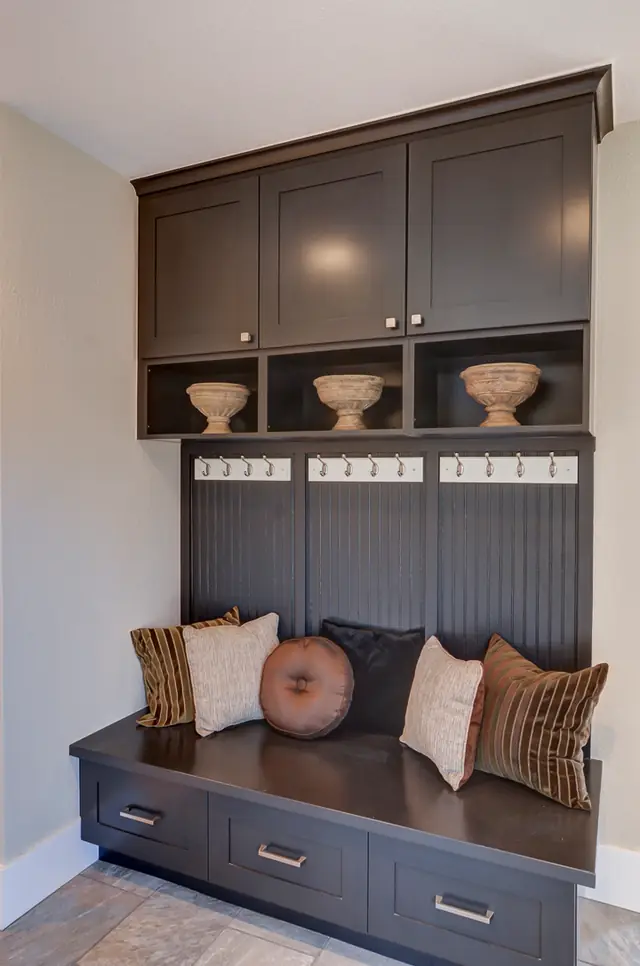
Custom work follows the same path. The mudroom bench with cubbies and hooks in the photo is the kind of built-in we scribe to the wall and anchor into framing, then leave ready for paint or stain. We measure for the family that will actually use it, how many coats, how many pairs of boots, how high a child can reach.
What does a finished carpentry job leave behind?
The goal is a surface you can paint without a second thought. Joints are tight, nail holes are filled and sanded, and caulk is run where the trim meets the wall so the line stays crisp. If you're repainting afterward, you shouldn't have to hide any of our work.
Doors should swing without catching and latch on the first push. Check them again after the first change of seasons, because wood takes up and gives off moisture, and a door that's perfect in October can brush the frame in July. A quick adjustment is part of normal life with real wood.
All of our labor carries a one-year warranty. If a piece of trim lifts or a hinge loosens inside that year, call us and we'll make it right. And if you've been meaning to fix something else while we're on site, tell the craftsman before the hours are up. Adding one more item to a visit is cheaper than a second trip.