Why do new floors buckle, gap and squeak?
Floating vinyl and laminate planks are only as flat as what's under them. Lay them over a subfloor with a high seam, a dip near the wall or a patch of old adhesive, and the joints flex every time someone walks across. That's where you get the click-clack sound, the ridge you can feel through a sock, and the plank edges that chip open within a year.
The other classic failure is a floor that's pinned in place. Planks need room to expand and shrink with the seasons, and Colorado swings from bone-dry winters to humid summers. Run the boards tight to the wall, or trap them under a heavy cabinet or a trim piece nailed through the floor, and the whole field lifts into a hump the first warm spell.
Transitions are where cheap installs show. A bare edge where the floor meets tile or carpet, a threshold that's a quarter inch proud, or a gap along a doorway that collects crumbs all say the same thing: nobody planned the room-to-room joint.
How does HIE put down a floor that stays put?
Prep comes before any plank leaves the box. We pull the old flooring, check the subfloor for movement and flatness, scrape and level what needs it, and lay the underlayment the product calls for. That's the unglamorous half of the job, and it decides how the floor feels and sounds for years.
Then layout. We find the starting line so the last row against the far wall isn't a thin strip, stagger the seams so the pattern doesn't read as a grid, and leave the expansion gap around the perimeter, hidden under baseboard or shoe molding. Each doorway gets a transition sized to the two floors it joins, so the step from room to room is clean.
A small room can be quoted from photos emailed to the estimates address; a whole level gets an in-home estimate. Both are free, and you can start with a call to 970-632-0138. We bill by the craftsman hour at $165 with a 4-hour minimum, our craftsmen carry at least fifteen years of experience, and we don't mark up the materials we buy. Fort Collins homes with a few rooms to refloor usually do best as one planned job instead of three separate visits.
What should you do after the floor is in?
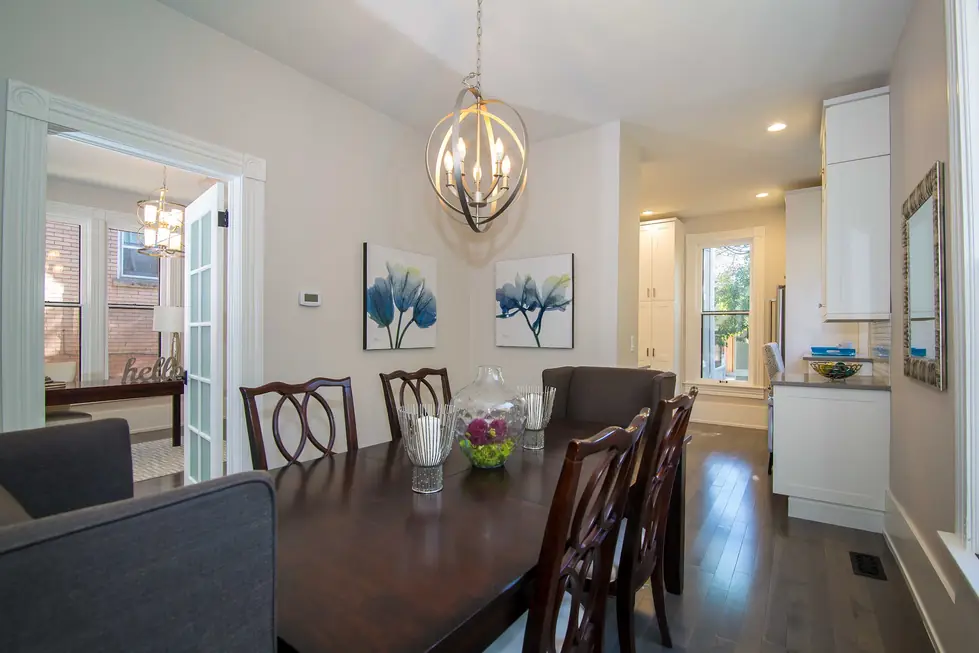
Keep the gaps free. Don't glue baseboard to the floor, don't fasten furniture through it, and put felt pads under chair and table legs so they don't scratch or pin the planks. The dining room in the photo is the kind of space where heavy tables and constant chair traffic make those habits pay off.
Clean with what the manufacturer recommends, not a wet mop. Standing water is the enemy at plank seams, especially near sinks, dishwashers and exterior doors. Wipe spills quickly, and use mats at entries to catch grit that wears the surface down.
All of our labor carries a one-year warranty. If a seam lifts, a transition loosens or a plank sounds hollow in that first year, call us and we'll come look. Keep a few spare planks from the job in a closet, since matching a discontinued pattern later is nearly impossible.